What Those Mystery Balances in Your Xero File Might Actually Mean
I ran a small hosting company for 11 years. An accountant did our year-end every year, the tax returns were filed on time, and I never thought much about it. The books were in Xero, the accountant had a login, and I assumed that between us the numbers were right.
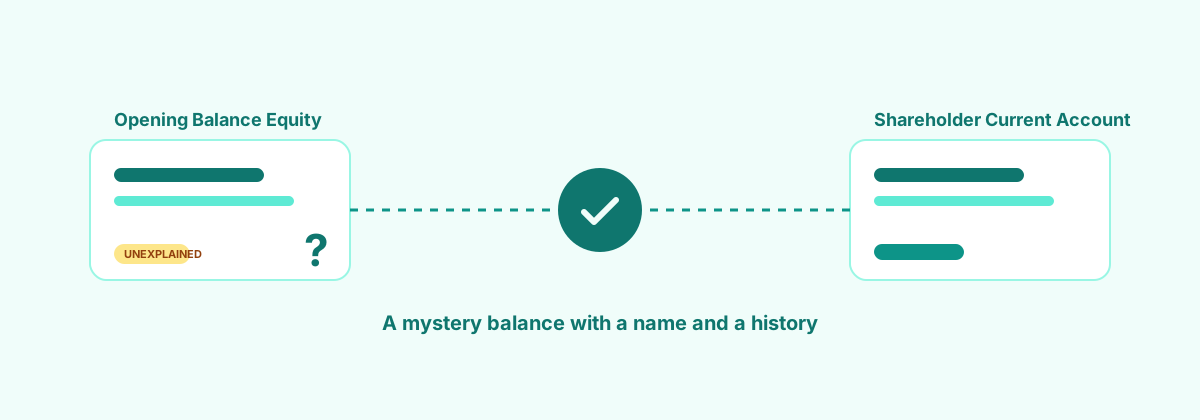
Then I moved the books into FinchKeep, and for the first time I actually looked at my own balance sheet. Sitting in Opening Balance Equity was about $18.7k that nobody had ever explained to me.
I'm a developer, not an accountant, so I went digging. This post is what I found. Your books will differ from mine, so treat it as a list of things worth checking, not a diagnosis.
Why your Xero balances may not match reality
Here's the thing I didn't understand for 11 years. Your accountant's year-end work doesn't necessarily end up in your Xero file.
Plenty of accountants prepare the final accounts and tax return in their own software, with their own ledger. Adjustments made there, such as depreciation, accruals, tax entries and shareholder account tidy-ups, can stay there. The returns can be filed correctly while your day-to-day books never receive the matching entries.
That's not negligence. It's often just how the workflow goes. But it means your Xero file can drift away from the financial statements your accountant signed off, and nobody notices until you move the data somewhere else.
Opening Balance Equity: what it is and why it might be your shareholder current account
When you import books into a new system, the opening balances have to come from somewhere. Whatever doesn't fit neatly into another account can land in Opening Balance Equity. It's a holding account, and it's meant to be temporary.
In small NZ companies, a big chunk of it may turn out to be the shareholder current account: the running balance of what the company owes you (or you owe it). Mine was the company owing us, for years of funding losses and home office costs. My accountant tracked it in their own ledger every year and never posted it back to Xero.
How to check yours:
- Find the shareholder current account balance on your accountant's most recent financial statements.
- Compare it with your Opening Balance Equity (and any shareholder accounts already in your file).
- If they match, you've probably found it. A journal can move the balance to where it belongs.
- If they don't match, look at the usual suspects: bank accounts that were never fully reconciled at the cut-off date, and accruals (things owed or owing at year-end) that were missed.
An unexplained balance isn't necessarily an error. But it's worth being able to say what it is.
Drawings, funds introduced and terminal tax paid
Many small companies end up with several accounts that are really the same thing wearing different hats:
- Drawings: money you took out personally.
- Funds introduced: money you put in.
- Terminal tax paid: tax paid on your behalf or from personal funds.
Depending on how your company is set up, these can all belong in one shareholder current account. That account is a liability: it shows what the company owes you, or if the balance is the other way, what you owe it. Spread across three or four accounts, the picture is hard to read. Consolidated, it tells a clear story: here's the net position between me and my company.
A simple example. You put $5k into the company to cover a bad month:
Dr Bank                         $5,000
  Cr Shareholder Current Account       $5,000
Later the company repays you $2k:
Dr Shareholder Current Account  $2,000
  Cr Bank                              $2,000
The company now owes you $3k. One account, one number.
Retained earnings vs the loss carried forward on your IR4
This one confused me too. My retained earnings in the books didn't match the loss carried forward on the company's IR4.
They can legitimately differ. Your books record everything the business spent. Tax rules don't allow every expense as a deduction. Non-deductible expenses (entertainment is a common one) reduce your accounting profit but not your taxable profit, so the two figures can drift apart over the years.
So a gap between the two is not automatically a mistake. The question to ask your accountant is whether the difference is explained by non-deductible items and timing.
Home office claims
If you work from home, you may be able to claim a share of household costs. I had never really understood how this looks in the books.
One common way to record it is as a journal that needs no cash at all:
Dr Home Office Expense          $1,200
  Cr Shareholder Current Account       $1,200
The company has an expense, and it now owes you that money, because you paid the household costs personally. No bank transaction happens. The liability just sits in the shareholder current account.
Later, when the company has spare cash, it can pay you back:
Dr Shareholder Current Account  $1,200
  Cr Bank                              $1,200
That payment is the company repaying a loan, rather than paying you income. Which is how mine added up over the years: a good chunk of that $18.7k was exactly this, plus the losses we'd funded personally while the business was getting started.
How the rules apply to your situation, including what you can claim and how, is a question for your accountant or IRD. I'm only describing how the bookkeeping can look.
A checklist for your own books
If this sounds familiar, here's where I'd start:
- Reconcile every bank account to the statements. Make sure the balance in your books matches the bank at each year-end, not just today. Many mystery balances start here.
- Investigate Opening Balance Equity. Don't leave it as a permanent resident. Ask your accountant what it is, and compare it with their financial statements.
- Consolidate your shareholder accounts. Drawings, funds introduced, terminal tax and home office entries may all belong in one current account.
- Set a lock date. Once a year is finalised, lock it so it can't quietly change. FinchKeep has a lock period setting for this, and so do most accounting packages. It saves arguments with your future self.
I did all four after moving to FinchKeep, and the thing that surprised me was how little of it was technical. The hard part was asking the questions. Once I could see that $18.7k had a name and a history, the balance sheet finally matched the story I already knew about my own business.
Where this leaves you
None of this was hidden from me. It was in my accountant's records the whole time, and I could have asked. But I never had a reason to look until the numbers sat in a system I could poke around in myself.
You don't need to become an accountant. It's enough to understand what your own books are saying, so that your conversations with your accountant are two-way rather than "here's the folder, please make it right."
This is general information from my own experience, not tax or accounting advice. Every set of books is different, so please confirm your own situation with your accountant or IRD.